
A Conversation with Barbara Byar
In the Desert under the endless sky

A short bio, to start. Barbara Byar is an American writer who’s been living in Ireland for over twenty-five years. Her short story collection, Some Days Are Better Than Ours (Reflex Press) was short-listed for the Saboteur Awards. She was shortlisted for the Irish Book Awards Irish Short Story of the Year in 2023 and longlisted in 2021.
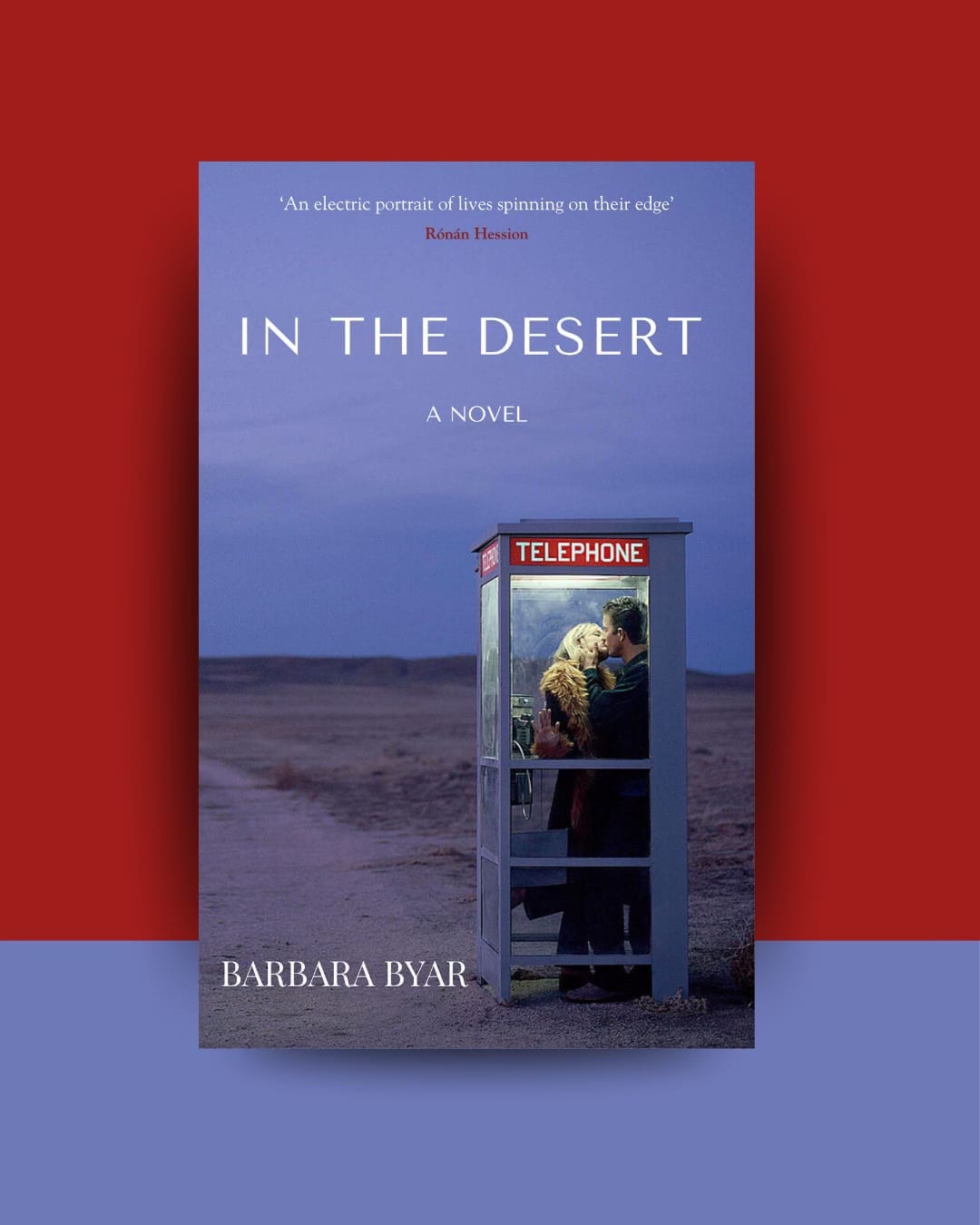
I met Barbara three years ago when she edited the Motel anthology (published by Cowboy Jamboree Press), a brilliant collection. Barbara’s debut novel In the Desert came out in March, and it is extraordinary. Reviewers call it bold and thrilling. It’s also beautifully written. Of course I wanted to talk to Barbara about it.
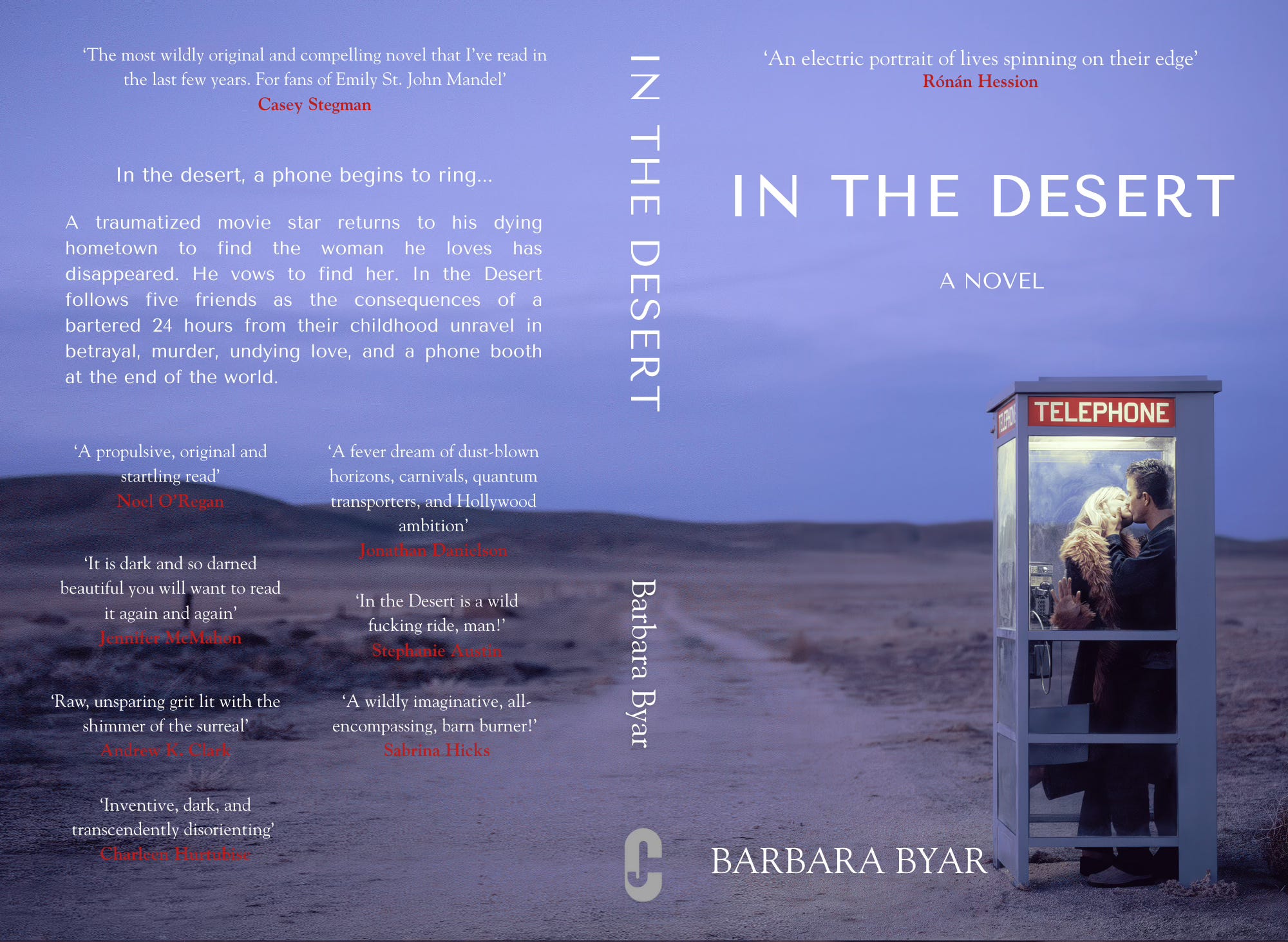
M.E. Proctor: In the Desert is an amazing novel. It is literary and crosses every genre boundary on the bookshelf. The structure is non-linear, with multiple plot threads, and one of the most exciting finales I’ve ever read. Where did the idea come from?
Barbara Byar: I’ve been thinking about writing Desert since the 90s when I went on an epic road trip through the American southwest. In 2022, I got serious about it.
MEP: Now I want to know about that road trip …
BB: I remember it so clearly. Or at least parts of it. Certain events become part of our fabric and while fabric can shrink, stain, or tear over time, the rags remain in our memories.
Back in the mid-90s, I finished a 6-month hellish project with a psychotic boss down in L.A. The experience put me off working in the project management field forever. I had enough severance and savings to take a year off to write that book I always wanted to write. So, I moved to San Francisco, found a share-rental in the Mission, and learned how to live lean again. Near the end of that year, I got a phone call. I was in my room staring at my desk in the bay window, brilliant sunshine, thinking: it’s such a lovely day, I should be outside.
Alvin, a friend of mine from Boston, was on the phone. Well, he was mainly a friend of my ex’s who I had left behind but he was a friend of mine as well. He’d read an article about this church in SF called The Church of St. John Coltrane which worships to the music of John Coltrane and thought it was the coolest thing he ever heard. So he and his buddy, Brian, in a 70s Impala they nicknamed Buddha, drove cross country to see it and pick me up on the way for the return journey.
I was game and after a few days showing them around SF, I threw some clothes in a bag and hopped in the back seat. So began the road trip of a lifetime. We drove down through central California where the thermostat blew on the Impala in the middle of Death Valley. Onto Vegas where we picked up a girl named Shari. Then through Southern Utah, Northern Arizona, Navajo Nation, Monument Valley, the Grand Canyon, Alvin’s folks’ home in New Mexico, and finally Santa Fe where I caught the train back to SF.
On the long train journey back, I wrote this epic travelogue poem, hoping to capture the trip before I forgot anything/everything. That journey caused a fundamental shift in my perception of the world and my place in it. I thought the poem was lost, but when I looked through old emails to Alvin, I found the guts of the poem in an old document.
Here’s a small bit:
The next time I fall in love,
she says
it will be with the one who looks me in the eye
and says
“Let’s go,”
He nods as if he understands
but
could never be
so free.
The entire trip, Alvin, who is a filmmaker, was flapping this pixelvision camera around at us, at everything. I’ve been nagging him for years to uncover that footage. I’m certain there’s moments, events, conversations, I have forgotten captured in that toy camera. I didn’t take any pictures but there’s a few from Alvin. This is a favorite of me in our Vegas motel. Note the room number.
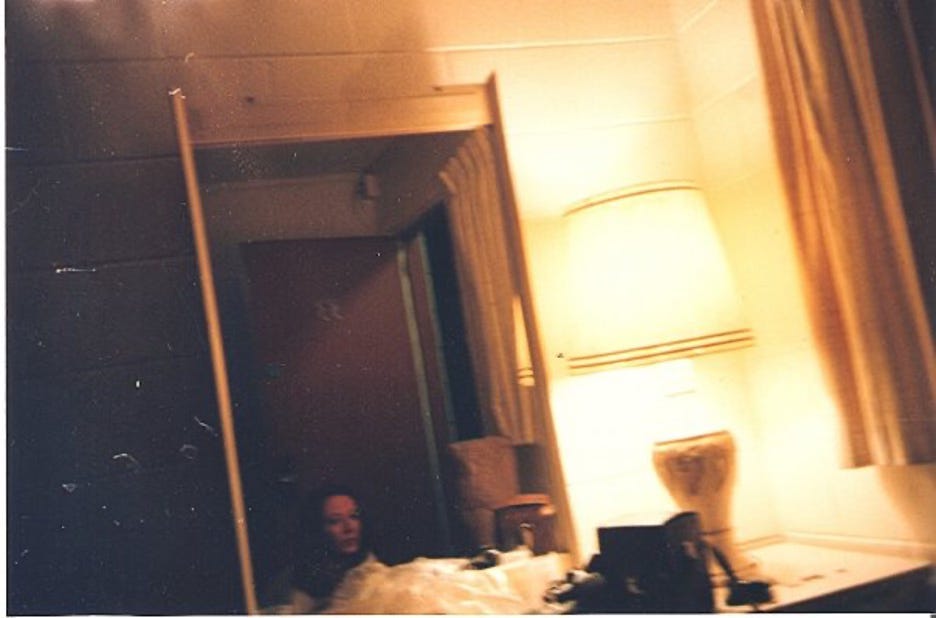
MEP: I had to get a magnifier, but yes, Room 33, of course. Raphael and Jessie’s room at the motel, in the book.
BB: When it came to writing In the Desert, I pulled out those rags of memory, the emotions and sense of time and place so intricately associated with them. My book is informed by all of that, but mostly that nothing in this world will awaken you to the possible more than standing in the middle of nothing, in the middle of nowhere, under an endless sky.
Saying that, Desert has none of my own direct personal experience in it. That may sound contradictory, but the narrative is pure imagination.
MEP: It’s a complex book. How did you build it? The timeline is fractured, some places are real and some are not, and yet, reading it, I was never lost in the puzzle. Did you outline, with all the pieces in place?
BB: I started with a premise—a washed-up movie star returns to his dying hometown to kill himself, finds a note in a motel room Bible from his lost love and vows to find her—that’s all I had, and it just went from there. At first, I jotted down a bunch of notes, thoughts on scenes. Some of these were really out there, and I recall telling myself, nah, you can’t do that, but I had an epiphany early on. I reminded myself that I was writing FICTION and that meant I could write whatever the hell I wanted, I just needed to make it believable and make it work.
From that point on, I was juiced. I remember telling my writing friends, Ashling and Davena, all these crazy plots and subplots over a meal. I was SO excited about it all - “Then they’re going to do this, and then that, but wait, then this happens, and it’s linked back to this and chapters won’t have numbers but be in expressions of time...” and on and on. I have never been more excited about anything I’ve written. Because the narrative was based on pure imagination, it was not constrained by my experience, only the setting was and even then, I was like: there’s this phone booth in the middle of the desert, how is it powered? What if it’s magic? What if it’s a portal? What if I introduce this new character from another dimension, what if, what if?
MEP: I’ve had stories with too many plots and angles. Embarrassment of riches but it’s hard to make choices, and the story has to be coherent.
BB: Desert was an ENORMOUS amount of work to tie it all together. Someone who read it recently asked me if I had post-it notes on the wall and strings going from one subplot to the next—there’s a name for that, but I can’t remember what it is—and I said, no, I did it all in my head. They were shocked.
In fairness, it did take me ten drafts. In each draft, I found plot holes, smoking gun types of things. Even at the last draft, I was like, WAIT, he does this here, rewind to the four related scenes and check for continuity. One of the last things that came together was the song theme and I really loved what I did there. Before I fixed it, there were random mentions of songs/music and no cohesion, but introducing one minor character, then building a surprise reveal in the end worked wonders with that.
At no point did I become bored with the book. I did, however, nearly drive myself to tears trying to wrap the loose ends around one particularly stubborn subplot. It was never just rewrite a paragraph - it was always: if I change this, I have to change that and that and that, and oh, changing that leads to changing another subplot. You can imagine the absolute head wreck it was at times, but I loved it.
MEP: I hesitate to ask what you’re working on now. It’s such a ‘woof’ feeling to complete a book. All the time, the emotional investment … It can be disorienting to have to focus on something else.
BB: I’ve two novel projects lined up. It was difficult to pick which one to write next. One is another speculative realist (contradictory, I know but I think I pulled it off with In the Desert), the other is pure realism. The one I settled on is called Peace Process and is based on a short story I wrote which was shortlisted for the Irish Book Awards short story of the year. You can read it here: https://variantlit.com/peace-process/.
After that, I have another speculative realist epic lined up. Completely different subject matter than Desert but I’m really excited about it. That’s all I’ll say about it for now cause it’s a really exciting concept book.
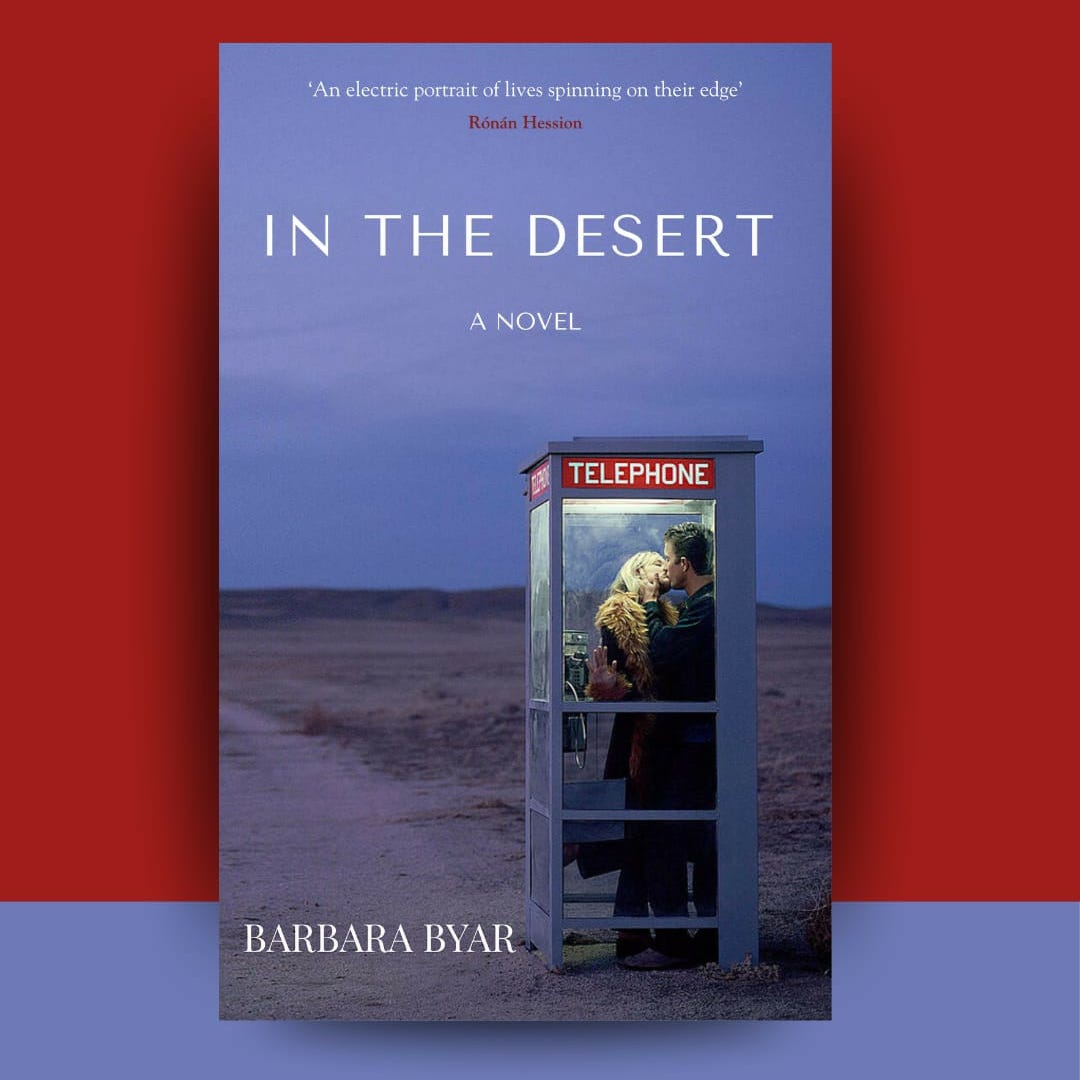
MEP: Count me in. I didn’t know what to expect when I started reading In the Desert. I didn’t even read the blurb. I just knew I loved the cover and I tried to imagine what was behind it. I was nowhere close, of course. The book is in the top of the recent releases I’ve read. It’s really special. I want to put it in people’s hands, I believe they’ll thank me!
BB: Thank you for having me, it means a lot. As you know, publishing with small and indie presses is tough. There’s no marketing budget or much marketing at all. We rely on word-of-mouth and people writing reviews to spread the word.
MEP: We absolutely have to beat the drum. Thanks for the talk, Barbara.
The book is available at Bookshop.org, Amazon (paperback and eBook), Barnes & Noble, and you can order it through your favorite bookshop.
Barbara’s website is at: https://barbarabyar.wordpress.com. She’s also on Substack at:
Thank you for reading. And yes, leave reviews, authors need them!
Well done M.E. and Barbara. Enjoyed that. - Jim
I'm adding the book to my TBR list. I went on a similarly transformative road trip when I was 20 in 1999. It never directly inspired a novel, though I got a few solid short stories and some bad poems out of it. And as someone who just finished the editing process for my own upcoming novel, the part about doing repeated drafts and the frustration regarding chain reaction edits really hit me where I live!