
Bringing Them All Together
in collection number TWO

A Book to Live By is available in Paperback and eBook - that’s on Amazon. There are more format options here: https://books2read.com/u/mVEQk2.
In the last post I talked about real life inspiration behind four stories in the collection (four out of twenty-four). This time, I want to tell you about voice.
Voice, in writing, is born from a mix of a lot of things. Personality, life experience, cultural and social environment. The things we’ve read. We all have favorite words and go-to sentence structures. Style, inclination. In some cases, the voice is so distinctive that a reader can attribute the work to an author after reading a page or less. Hemingway, Faulkner, Poe, Ellroy, Cormac McCarthy … Of course these strong voices are imitated, consciously or unconsciously. Read enough James Ellroy books and you’ll start writing like the man. I know, I’ve been there. His rhythm is contagious. And now AI is delivering a voice indigestion: Hey, Robot, rewrite my story in the manner of Raymond Chandler.
(The line is thin between homage and plagiarism. I’m in no way suggesting that using AI to write like Chandler is a respectful tip of the fedora, quite the opposite, it’s an insult.)
Some people read my work and say, oh these stories are so like you! I’m not sure what it means. I certainly don’t speak like I write—in fiction anyway, these substack posts are closer to my natural rhythms. But my storytelling must reflect who I am, where else could it come from?
I doubt my style (voice) is unique. I tend to favor short sentences, I use periods more than semi-colons. I probably stick too many commas in there because I hear the text in my head and commas are breathing breaks, an actor’s pauses. Writing is music and I have my favorite melodies.
Sometimes I deliberately go against my grain.
Instead of letting the mind do its regular hop, skip, and stroll, I force it to go somewhere else. A place that is still me, but in disguise. I use a voice that is not my natural one.
Here are three examples from the collection, A Book to Live By.
1. Jeanne and the Imp. Coy Hall (interview here) who writes gorgeous historical fiction put out a call three years ago for an anthology. The stories had to be set during WW1 and include a horror component.
Being born in Brussels, I thought about my city conquered and occupied, and the hardship that ensued. I remembered the story of Edith Cavell, a British nurse and hero of the resistance, who was executed by firing squad. Miss Cavell has a street, a hospital, and a nursing school named after her. Not far from where I used to live.
Jeanne and the Imp features a young doctor, Gabriel, and a student nurse, Jeanne, caught in the chaotic events.
The historical facts had to be accurate (up to the point where fiction takes over), but finding the right tone for the story was crucial. A slower tempo. A degree of caution and restraint. Gabriel doesn’t talk/think like a modern thirty-year-old. Neither does Jeanne (even if she’s more direct than he is). The sentences are longer, their construction is more complex, and the vocabulary belongs to a more formal time. Yet the words must sound lived in. Real people talking in real time, not some stilted costume drama reeking of mothballs.
In Gabriel’s words:
My name is Gabriel Mercier. I’m a doctor. Fatalism and resignation go against everything I stand for, against my reason for being. I fight illnesses, I fix injuries, I cannot afford to give in to the inevitable. Despair makes me useless. I cannot be a mere assistant to the gravedigger, but the days are dark and I struggle. I have so little hope left.
I like Gabriel and Jeanne. I might go check on them some day …
2. Circe. This one came from a call for stories inspired by Shakespeare’s plays. Instead of heading to the Italian Renaissance or the English late Middle Ages, I went back two millennia to poke at Antony and Cleopatra. I rewrote and expanded the story for the collection.
Tony and Cleo are never on stage. They’re ‘the people that other people talk about’, the celebs and scandal couple of their time. The narrator is Marcus Agrippa, Octavius’s general. I steeped him in skepticism and gave him a deadpan sense of humor that flies several Roman miles above the head of his buddy, the terribly serious future emperor Augustus. Time travel is one the most fun aspects of this writing gig. Here again, I wanted the voice to be realistic, rooted in human behavior, not a spoof or parody in a toga. My writing has a different rhythm here. The clacking of hobnailed boots on marble. I can picture the movie …
Here’s Agrippa giving a primer on Egyptian religion and politics to his friend:
“They have animal heads. The goddess married her brother, and another brother killed him, chopped him up and dispersed the pieces. She put his body back together and fucked him. A son was born.” The expression on Octavius’s face was priceless. “Don’t ask me how they made that work. Anyway, that’s why pharaohs marry their siblings. They also happily kill each other. Brothers, sisters, cousins. It’s amazing there’s anybody left alive to rule. Exceptional family values.”
He’s about to realize that his hard-nosed rationality can’t explain everything.
3. Confessional. For this story I switched to full gothic mode. A ruined church, tomb raiders, a mysterious object pried from a skull … it will not end well. And it rains from beginning to end. There’s a graphic novel feel to this story, and the writing leans gleefully into it.
A snippet:
The tall bell tower collapsed years ago and the building looked more like a barn than a house of worship. Not that anybody worshipped there anymore. The old faith had died long ago and the countryside was littered with its remains. You couldn’t travel a mile without running into dilapidated chapels and cloisters, moss-covered oratories and the countless broken crosses that stood guard at every fork in the road. Ryder shrugged to hide a shiver that had nothing to do with the dreary night. He hated these ancient structures. They were dark, primitive, and hulking; places where cruel men used to bow in front of cruel gods. The kind of gods that passed judgment with fire and blood on peasants who were miserable enough without the help of any divine intervention. The old gods were a scam. The new ones too.
I wish I had a smidgen of talent with a brush. The picture would be in stark black and white, with impenetrable shadows.
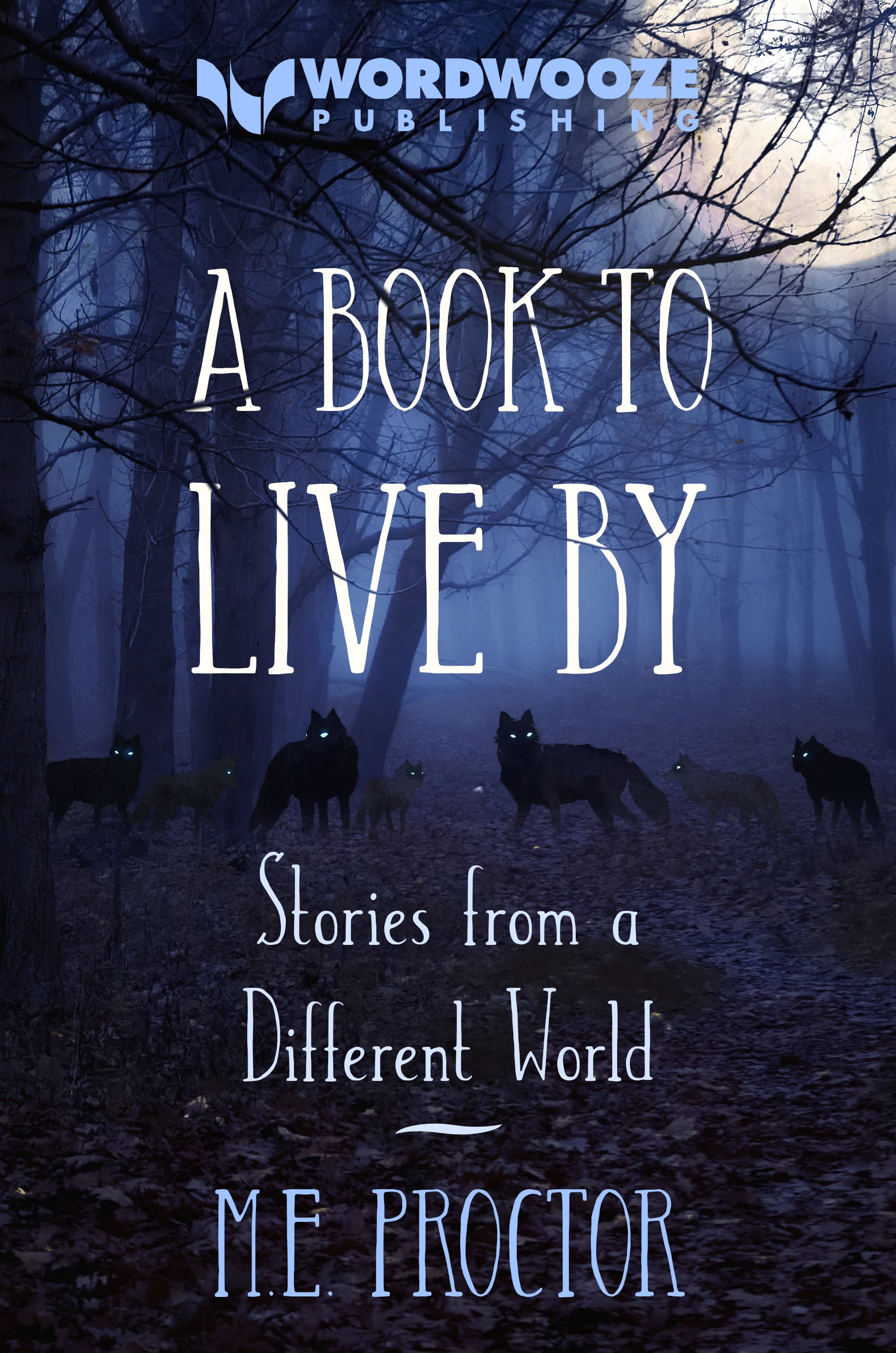
These are teasers, one-bite appetizers. A hint of what’s behind the book cover with the eyes glowing in the dark. Maybe you know my crime stories, if that’s the case this collection will take you to a different place and I hope you enjoy the journey.
A Book to Live By is available now (from Wordwooze Publishing) in Paperback and eBook, on Amazon. And in Books2Read for more options, here: https://books2read.com/u/mVEQk2.
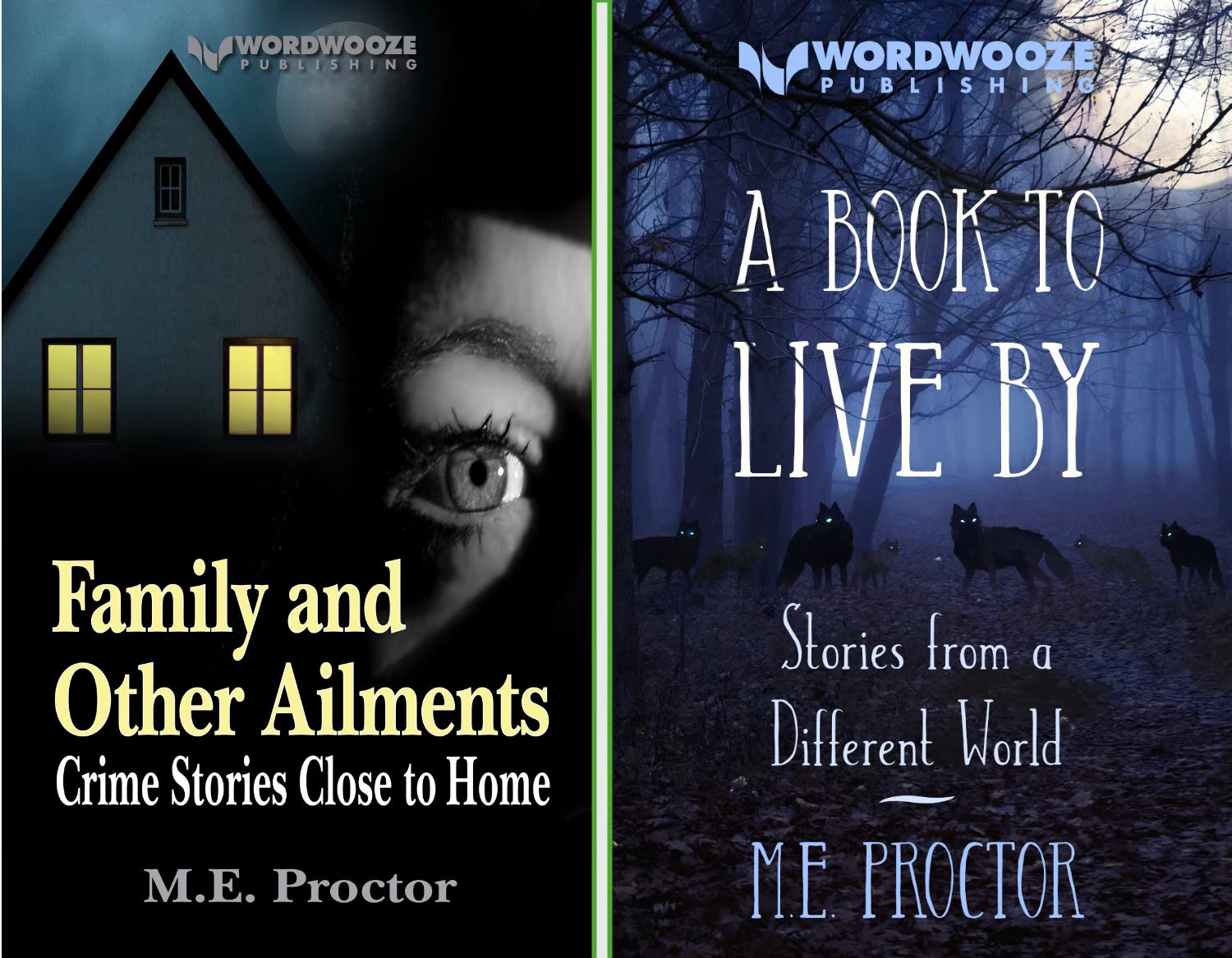
A Book to Live By is my second short story collection, after Family and Other Ailments. You can find it in eBook (multiple formats), Paperback, and Audiobook at Books2Read.
Oh my goodness. I, too, find my pacing and word usage change depending on my fav author de jure. I catch myself assuming their voice and have to beat it out of my head to write in mine! The advantages, however, are immense when my craft is challenged and improved. Well put, Martine. And I love the examples! Great stuff.
I can only write in my voice. It's kinda crippling : ) Your books look great Martine congrats